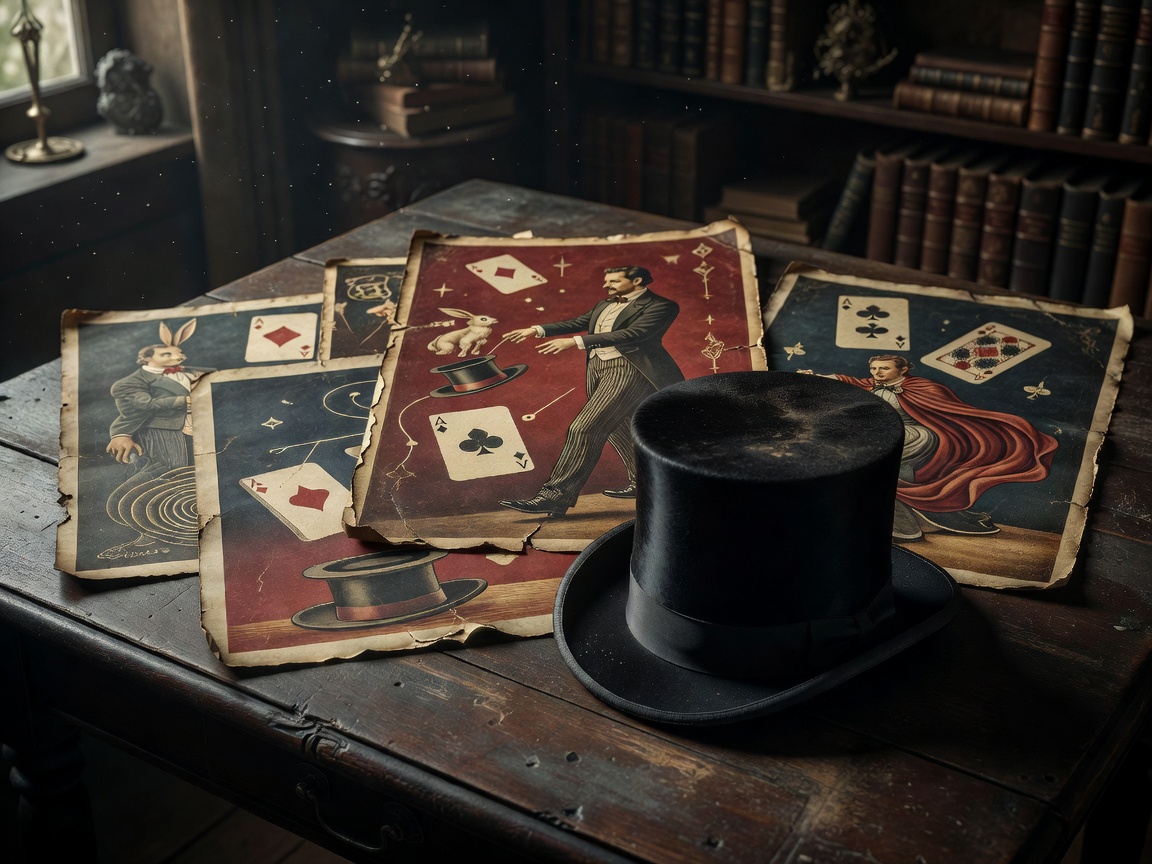
The performance of magic is one of the oldest art forms in human history. Long before it was considered theatrical entertainment, deception was utilized as a tool for political power, religious authority, and survival. Tracing the history of magic is tracing the history of human belief and our evolving understanding of the natural world.
Ancient Origins and Shamanism
The earliest documented account of a magic performance dates back to Ancient Egypt. The Westcar Papyrus, a text from the Middle Kingdom, describes a magician named Dedi performing for the Pharaoh Khufu. Dedi allegedly decapitated a goose and a pelican, only to restore them to life unharmed. In ancient temples, priests used early knowledge of hydraulics and acoustics to make massive temple doors open seemingly by themselves, and to make stone idols "speak." These illusions were not presented as tricks, but as manifestations of divine power.
The Middle Ages and the Street Juggler
During the Middle Ages, magic shifted from the temples to the streets. It became the domain of the traveling mountebank and the juggler. The classic "Cups and Balls" trick, depicted in a famous painting by Hieronymus Bosch, was a staple of street performers. In this era, performing magic carried a genuine risk. The line between a clever trickster and a practitioner of witchcraft was perilously thin, and many performers faced accusations of genuine sorcery from religious authorities. To survive, early magicians often published texts exposing their own methods, explicitly stating their feats were purely natural to avoid persecution.
The Golden Age and the Move to the Theatre
The 19th century birthed the "Golden Age of Magic." The pivotal figure in this transition was Jean-Eugène Robert-Houdin, a French clockmaker widely regarded as the father of modern magic. Prior to Robert-Houdin, magicians performed in heavy, mystical robes adorned with occult symbols. Robert-Houdin stepped onto the stage in formal evening wear. He transformed magic from an act of street corner hustling into a respectable, intellectual evening of theatrical entertainment.
He utilized electromagnetism and advanced mechanics—sciences largely unknown to the general public at the time—to achieve miracles. His legacy was so profound that decades later, a young Ehrich Weiss would adopt the stage name "Houdini" in his honor.
Vaudeville and the Grand Illusionists
By the late 19th and early 20th centuries, magic shows required entire trains to transport. Performers like Harry Kellar, Howard Thurston, and Harry Houdini were global superstars. This was the era of the grand illusion, where women levitated, elephants vanished, and men escaped from sealed milk cans. The posters from this era remain some of the most beautiful and sought-after lithographs in the world of collecting.
The Television Era and Modern Magic
With the advent of television, magic underwent another massive paradigm shift. Performers had to adapt to a medium that could beam their act to millions simultaneously, but where the camera frame dictated exactly what the audience saw. Pioneers like Mark Wilson created the template for televised magic. Later, performers like David Copperfield brought cinematic production values to stage specials, while David Blaine sparked a revolution by taking magic back to the streets, focusing entirely on the visceral reactions of everyday spectators.
Today, the art form continues to evolve. The internet age has democratized the learning of magic, allowing techniques to cross the globe instantly. Yet, despite all the technological advancements, the fundamental goal remains exactly as it was in ancient Egypt: to evoke a momentary sense of pure, childlike wonder.