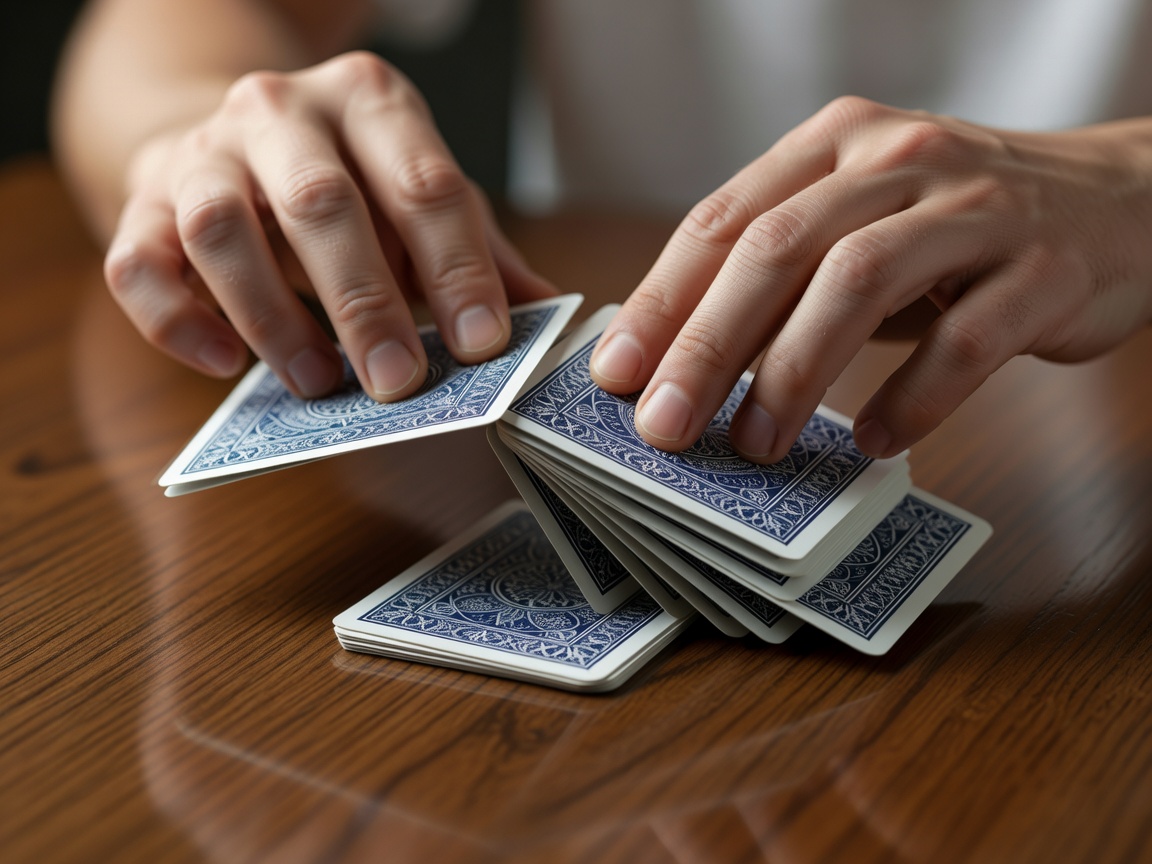
Magic with playing cards is arguably the most accessible yet deepest branch of the conjuring arts. A deck of fifty-two cards is universally recognized, inexpensive, and capable of generating an infinite array of mysteries. However, mastering card magic requires more than just memorizing a sequence of moves; it demands a thorough understanding of mechanical grips, tension, and audience psychology.
The Tools of the Trade
Before executing a single sleight, the practitioner must understand their instrument. Most professionals prefer standard poker-sized playing cards with an "air-cushion" or embossed finish (such as the standard Bicycle deck). This finish allows the cards to slide smoothly over one another, a critical requirement for fanning, spreading, and executing false counts. Cards made entirely of plastic are highly durable but tend to stick together, making advanced sleight of hand significantly more difficult.
Core Grips and Postures
The foundation of all card magic lies in how the deck is held. Improper grip leads to flashing (accidentally exposing a card) and muscle fatigue. The two most critical holds are:
- The Mechanic's Grip: The deck rests in the palm of the non-dominant hand. The index finger wraps around the top short edge, while the middle, ring, and pinky fingers rest along the long edge. The thumb rests along the opposite long edge. This grip provides total control and squares the deck seamlessly.
- The Biddle Grip (End Grip): The dominant hand holds the deck from above. The thumb grasps the bottom short edge, while the middle and ring fingers grip the top short edge. The index finger rests lightly on top of the deck, often curled to apply slight pressure. This grip is essential for picking up cards and executing counts.
Essential Sleights
While the library of card moves is vast, a performer can build an entire career on a handful of well-executed fundamentals.
The Double Lift
Perhaps the most utilized move in all of card magic, the Double Lift involves turning over the top two cards of the deck as if they were a single card. This allows the performer to display a card, turn it face down, and instantly deal a completely different card onto the table. The secret lies in a subtle "pinky break" obtained under the top two cards before the turnover is initiated.
Forcing
A force is a technique that gives the spectator the illusion of a free choice while the performer secretly dictates exactly which card is selected. The Cross Cut Force and the Riffle Force are standard examples. A flawless force relies heavily on timing, casual body language, and a lack of tension in the performer's hands.
False Shuffles and Cuts
To convince an audience that the deck is hopelessly mixed while actually retaining a specific order (either the whole deck or just the top few cards), false shuffles are employed. Techniques range from simple false cuts on the table to intricate in-the-hands sequences that mimic standard overhand shuffling mechanics perfectly.
The Psychology of a Card Trick
Technique alone is sterile. The true magic happens in the spectator's mind. A strong card routine builds a logical narrative. If you claim to have found their card through psychic ability, your body language should reflect deep concentration, not the smugness of a card sharp demonstrating a sleight. Furthermore, the concept of "offbeat" is vital: a move should be executed precisely when the audience relaxes, which usually occurs immediately after a moment of tension or a laugh.
Practice Methodologies
Practicing card magic should initially be done without a mirror, focusing entirely on the tactile feedback of the cards. Once the hands know where to go without conscious thought, a mirror or video camera should be introduced to check for bad angles and flashes. Ultimately, a move must be practiced until it can be executed while maintaining unbroken eye contact and conversation with a spectator.